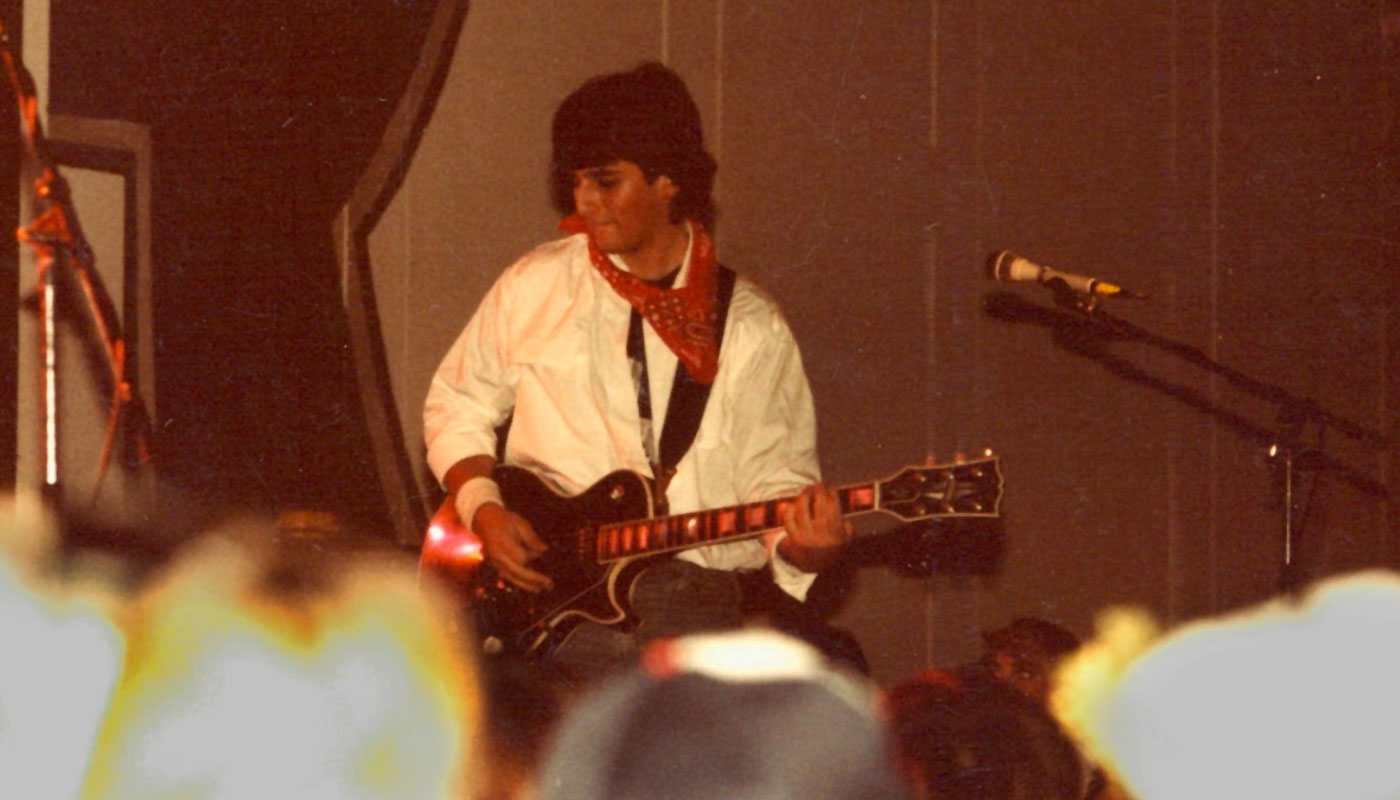
Yeah, I was an 80's kid, sue me.
Background
Yeah, I was an 80's kid, sue me.
He got into guitar the way a lot of people do — obsessed with The Who, playing air guitar on a tennis racket. His mom walked in, caught him mid-performance, and suggested — not entirely kindly — that he might want to try the real thing.
At 14, he started lessons with "Mr. Elliot" — no first name, just Mr. Elliot — a 65-year-old classical teacher who believed the only good rock band was the Beatles, and their best song was When I'm 64.
Matt was hoping for A Day in the Life. Or Strawberry Fields. That wasn't happening.
So he borrowed a Who songbook from the kid next door, realized he could already read chord diagrams, and just started figuring it out. Twenty songs later, he was off and running.
He went on to study classical and jazz, eventually landing in the Studio Guitar program at USC Thornton. He reads music, knows the theory, knows the positions. He just never confused knowing all of it with actually sounding good.
After USC he landed in LA, playing guitar in The Hindu Stuntmen — alongside future members of Ozomatli, Jellyfish, and Beck. He eventually moved back to Chicago, thinking briefly about law school. That didn't last.
Instead, the 1990s: session work, sideman gigs, and eventually fronting Plutonium Hat and Wax Miranda — right in the middle of a scene that included Smashing Pumpkins, Liz Phair, Urge Overkill, Veruca Salt, Material Issue.
During that time, he also built a busy teaching practice on Chicago's North Shore — 30 to 35 students a week, with a waiting list. He taught because he enjoyed it, and because it gave him the flexibility to keep pursuing music seriously.
The shift came from watching a bandmate play solos that just fit. Melodic. Intentional. Nothing wasted.
Matt's playing was technically solid — and went nowhere. That was the realization: technique without purpose is just noise. From there, it became about understanding why things work. Less flash, more Mike Campbell. Parts that belong — and the flash only when it earns its place.
He moved back to LA in 2002 and spent the next two decades in visual effects, working in lighting and look development for film, TV, and commercials. The guitar stayed with him — just not as a career.
Along the way, he was asked to teach at Gnomon, one of the top accredited visual effects schools in the world. He ended up as Education Lead for the Generalist Track — overseeing the equivalent of a college major, teaching four classes per term, and supervising roughly 22 instructors. He also led school-wide instructor recruiting.
The thing that stuck with him wasn't the curriculum work — it was the underlying philosophy. A great chemist doesn't just memorize reactions; they understand how chemistry works, which means they can solve problems they've never seen before. CG is the same way. Students who understood the system could troubleshoot anything. Students who just memorized steps kept hitting the same walls. His handouts became obsessively detailed for exactly that reason — step-by-step enough that a student could reconstruct what happened long after the class ended. They circulated. Other students used them. He personally recommended graduates into production jobs because he'd trained them to a standard he trusted.
The parallel to guitar is exact. A player who memorizes scale shapes has memorized shapes. A player who understands how the neck actually works — the relationships between notes, why certain things resolve, how keys connect — can figure out anything in any key, on any part of the neck, without stopping to think. That's the difference between knowing steps and being able to solve problems. It's what he teaches.
In 2023, after the industry slowdown, his wife Amy suggested he start teaching again. He began working with a small group of students, which quickly grew through referrals into a steady roster.
He came back to it with decades of experience — as a player, a working musician, and an educator — and teaches very differently now than he did the first time.
These days, teaching isn't something he fits in around other work — it is the work. His focus is on the students in front of him — showing up, paying attention, and helping them actually get better.
The goal hasn't changed: help students hear what works, understand why it works, and get to the point where they don't need tabs to learn the music they love.
He teaches differently now. His students notice.
He lives in Atwater Village with his wife Amy and their son Bowie. Lessons are offered in person and online.
Book a free 30-minute consultation — by phone or Zoom.
Rock, blues, and alternative are home base. Songwriting too — structure, arrangement, how to make a part serve the song. Ear training, music reading, and theory are all part of the mix, in whatever doses actually make you a better player. Jazz and classical are part of the toolkit: I've spent serious time in both, and they'll make you better. But if you're looking for a jazz or classical specialist, I'm probably not your guy. If you're looking for a rock player who actually understands why the other stuff matters — that's a different conversation.
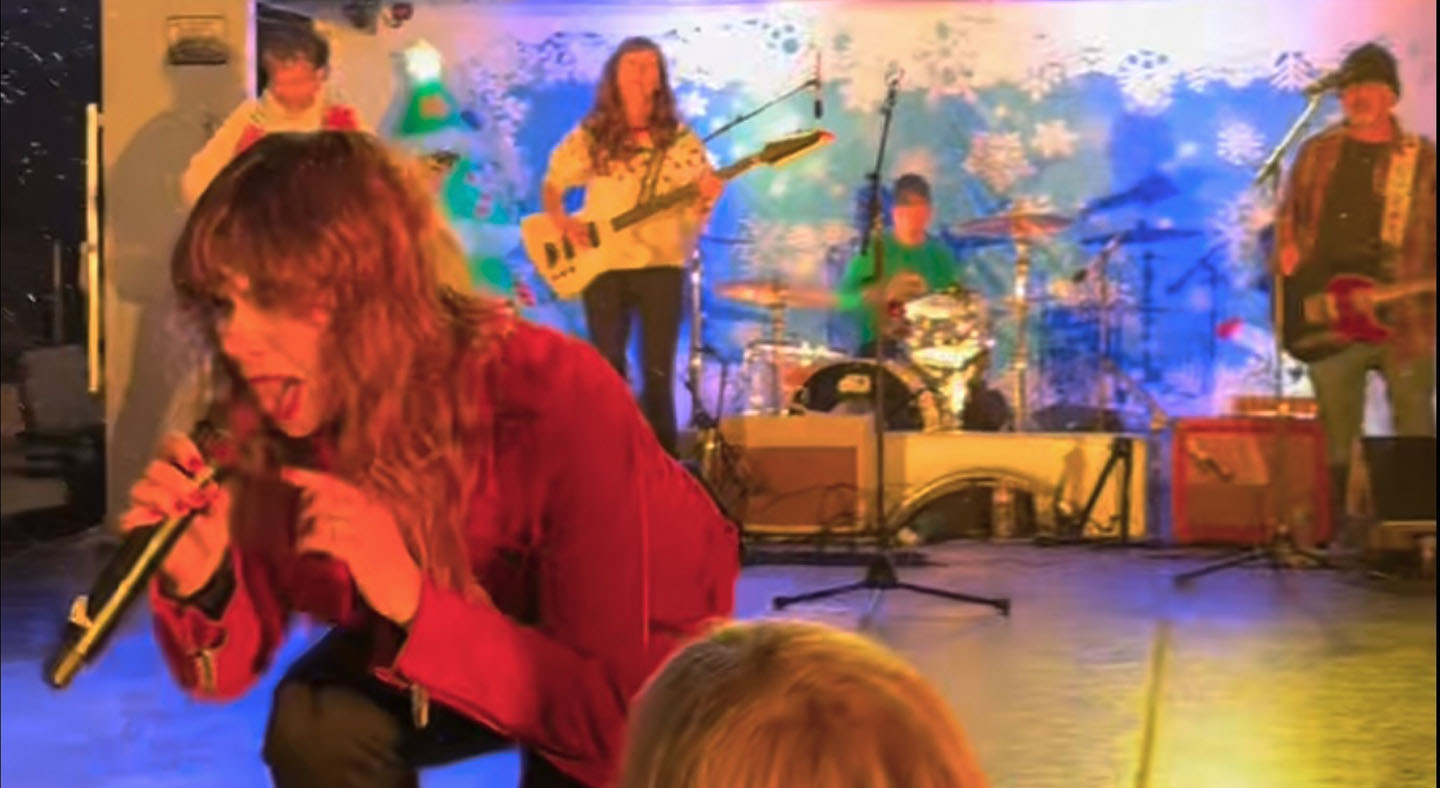
The Helicopters — Matt with Mark Tewarson (guitar, film composer), Kristen Jones (vocals, Shut Up Stella / Bullet and Snowfox), Nikki Monninger (bass, Silversun Pickups), and Stacy Jones (drums/MD — Miley Cyrus, Olivia Rodrigo, American Hi-Fi, Veruca Salt).
A free 30-minute call by phone or Zoom — tell me where you want to go.
Book a Free 30-Minute Consultation